
About Navigating Challenging Dialogue®
How we communicate with each other is vital to human existence. We need each other in order to innovate, solve complex issues, and even develop our best selves. And healthy conflict is a necessary part of the communication associated with creativity, innovation, forward progress, and problem-solving.
In today’s world, many of us face an increasing number of conversations where communication is messy, emotionally charged, or leads to unhealthy conflict. Without skillful practice, breakdowns in communication can result in a loss of trust, collaborations falling apart, progress stalling, and group dynamics feeling toxic.
Navigating Challenging Dialogue is a toolkit for building trust by developing self-awareness, emotional self-regulation, empathy, and curiosity. These skills are necessary for you to be effective in communication, leadership, and for incorporating coaching skills into the work environment. The NCD Process is a framework for fact-based dialogue, even when communication feels risky.
Communication and Trust are Essential, Even When You Disagree
Everyone benefits from practicing the skills of fact-based communication, emotional self-management, healthy conflict, and building trust:
- Leaders executing the strategic vision of their organization
- Managers guiding their teams to individual and group success
- Non-profit organizations managing nonstop changes in policies and resources
- Parents and families navigating a host of differing behaviors, beliefs, and language skills
Navigating Challenging Dialogue® is Your Roadmap
Early in my career, I got fed up with all the time I wasted clearing up my miscommunications. Through research and practice, I created Navigating Challenging Dialogue® (NCD). Using NCD and following my 4-step framework not only made me a better communicator, it improved all of my relationships, and I became a more effective leader.
Whether I’m facilitating, coaching, or training, I am using NCD to:
- Help my clients solve the challenge they’re facing right now.
- Teach my clients the tools to grow and sustain their success.
Today, Fortune 500s, nonprofit organizations, government agencies, and schools use the tools and strategies of NCD to become communicators who empower others through meaningful, drama-free conversations. NCD is a proven tool for improving culture, clarity, and retention in organizations.
More importantly, my client work has proven that practicing NCD makes it easier to build trust, which is critical for healthy relationships and successful organizations.
Practicing NCD Requires a Change in Your Thinking Patterns
The practice of NCD helps you to have difficult conversations in ways that build trust and strengthen connection, even when there is disagreement. The NCD Process includes a self-coaching tool that helps you to separate facts from emotions.
Incorporating NCD as a tool for engaging in communication measurably improves:
- Personal and family relationships
- Workplace culture and retention
- Team collaboration
- Organizational success
- Professional development
By following the NCD Process, you will be focusing on yourself, not on others. For most of us, this is a giant, and often uncomfortable, shift. Why? Because your ego’s job is to reinforce to you that you are smart, in control, and right. In fact, you are an expert. Your ego encourages you to focus on where others are wrong and to prove it to them through your words and actions. Your ego’s desire to maintain your perceived expert status shows up as behaviors that perpetuate unhealthy conflict.
As you learn the principles, key concepts, and skills of NCD, you’ll be more open to observe the interactions of others around you. You’ll notice where drama is being created through lack of clarity. You’ll start to see points in conversations where pausing to ask a few curious questions may avoid unhealthy conflict.
And often, the thinking patterns and errors we observe in others can reveal insights into our own thinking process. Observing the world around you is one of the ways the practice of NCD improves your ability to have even the toughest conversations in much healthier ways.
As you begin to experience more ease, you will notice places all around you where drama and conflict may be prevented. You’ll begin experiencing less drama, chaos, stress, and unhealthy conflict in your own communication. You’ll find the best way to introduce these concepts to others is to model the behavior you desire.
NCD Transforms Your Organization, Leadership, and Workforce
NCD is a proven framework for leading with empathy and curiosity by developing self-awareness and emotional self-regulation. Leaders and employees will build a high-performance culture of effective communication and collaboration. This methodology uses curiosity, feedback, and accountability to cultivate high potential/high performance staff.
As a proven framework, NCD transforms workplace culture, resulting in:
- employees who engage with curiosity, self-leadership, and creativity.
- employees who lead and manage with empathy and curiosity.
- teams who effectively communicate and collaborate.
- increased employee satisfaction, retention, accountability, and performance.
- managers who coach authentically and effectively.
- feedback being used as a tool for deeper employee engagement and building trust.
- success with long-term goals and in service of your mission.
NCD Mantras
NCD is built on core principles that I call the NCD Mantras. These mantras serve as simple reminders to help you stay grounded in the NCD Process even when communication is most difficult.
The more you practice the mantras, the more they will be integrated into how you show up as a communicator who listens, is empathetic, and holds space for others to be fully seen and heard.
- Be Aware of the Energy You Bring to The Room
- The Only Person I Can Manage Is Myself
- Grace in the Space
- That’s Fascinating
- Curiosity is the Pathway to Empathy
- Trust is Built One Conversation at a Time and One Experience at a Time
- You Can Only See the World Through Your Own Lens
- At the End of the Day, Everyone Just Wants to be Seen and Heard
As you learn the NCD Process, you learn the meaning behind each mantra and how to apply the mantra in different situations. The mantras are not something you necessarily say out loud or use in the conversation, but are reminders for you that help you stay within the framework of clean and clear communication and:
- be present
- listen
- use curiosity
- manage your own emotional energy
- create a safe space where others are seen and heard
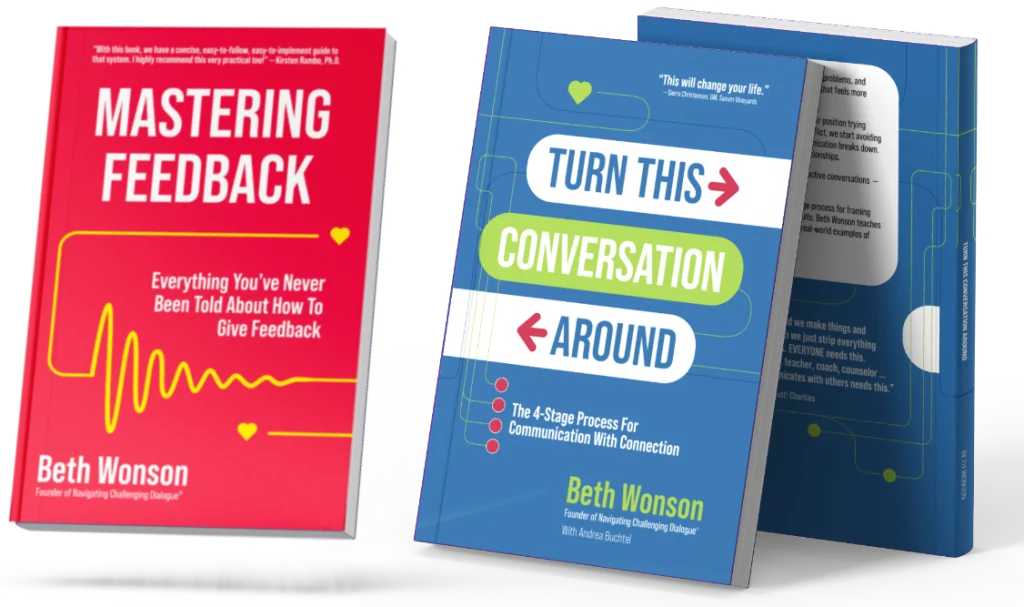
I’ve also written two books so you can learn the tools of NCD at your own pace.
- Turn This Conversation Around: The 4-Stage Process for Communication with Connection. This is the official handbook of Navigating Challenging Dialogue®.
- Mastering Feedback: Everything You’ve Never Been Told About How to Give Feedback
Book me as a speaker at your event
My presentations are rooted in Navigating Challenging Dialogue®, and are tailored to address the themes of your event. Check out my event offerings.
Navigating Challenging Dialogue® Workshops
These workshop are uniquely effective because attendees work with their own scenarios for all activities and practice, so they leave with tools they can apply immediately. All team workshops include a pre-meeting with Beth to ensure any leadership concerns or target areas are addressed.
- Navigating Challenging Dialogue® Essentials: Our flagship leadership and communication workshop for all levels of staff. Using their own real-life challenges, your team will come together to practice the proven tools for effective, fact-based dialogue, even when communication feels risky. This course transforms how you engage with others and handle conflicts, and you leave able to effectively apply the process to your situations. As a result, your team develops a shared language and set of norms for using NCD in the workplace.
- Mastering Feedback: Our trust-building workshop that teaches the step-by-step NCD feedback process. Through hands-on practice, you’ll be able to effectively apply the feedback process to the conversations you’re facing as a colleague, manager, and leader. Your team develops a shared understanding for how to use feedback in the workplace.
- Coaching in the Workplace: Our 2-day workshop for leaders and managers. This is especially important for teams that face retention and performance challenges. Your team will practice the authentic coaching skills required to close the gap between a staffer’s potential and performance, all while fostering their growth and development. Even people with a natural propensity to be a good coach need training to build that talent into a valuable skill. Your team will leave with a shared toolset and language for coaching in your workplace.